The U.S. Department of Homeland Security (DHS) has officially announced new rules for international students on F-1 (and J-1) visas, repealing the flexible accommodation system. Duration of Status (D/S) which has been around for decades.
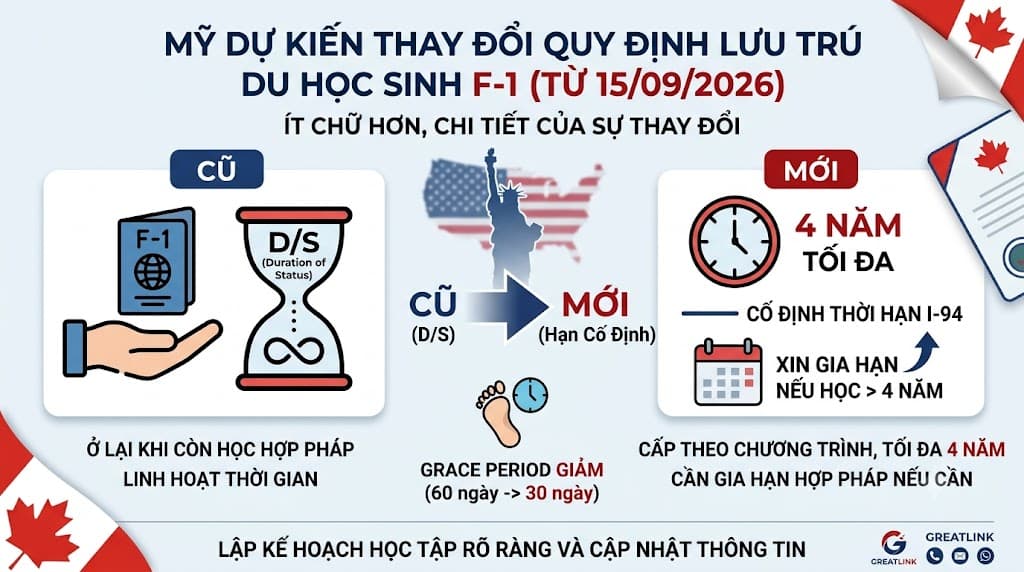
Instead of staying in the U.S. the entire academic process as before, since... 15/09/2026, international students will only be granted a fixed stay on Form I-94, maximum not more than 4 years.
This policy change requires new students as well as current students studying in the United States to proactively understand the regulations to build a legal and safe study pathway.
1. Key Changes In The New Regulation
D/S mechanism abolished – Maximum stay of 4 years
In the past, when entering the United States with an F-1 visa, a student's I-94 card was usually marked with the symbol "D/S". This means that you have the right to stay in the United States legally as long as you maintain full-time study and maintain a valid SEVIS status.
According to the new regulations:
- Legal stay period will be based on the end date of the program on Form I-20, but no more than 4 years.
- The exact expiry date will be indicated on the entry declaration Form I-94 (Admit Until Date).
Required Application for Extension (Extension of Stay - EOS)
If the program lasts more than 4 years (such as engineering, medical, doctoral...) or you need more time to complete the certificate, transfer, do the OPT/STEM OPT procedure:
- You will have to apply for Residency Extension (Form I-539) to the US Citizenship and Immigration Services (USCIS).
- The application should include fees, biometrics, and USCIS approval to remain in the US legally.
- In addition, students can also choose to exit and re-enter the United States with a new I-20 to renew the I-94 deadline.
Grace Period shortened from 60 days to 30 days
Free Extension Period (Grace Period) after completion of the program or completion of the OPT for international students preparing to leave the U.S., school transfer or immigration status transfer will be reduced from 60 Days Down To 30 Days.
Strict limits on transferring schools, changing majors and re-learning
DHS also implements tightening measures to manage the learning process:
- English Language Courses (ELT): Maximum total study time limit 24 months.
- School transfer/Change of major: Freshman and graduate undergraduate students will be restricted from transferring schools or changing majors for the first time without special reasons approved.
- Intermediate/Backward learning: Do not allow students who have completed one level of study to re-enroll in another program at the same level or below the level completed under the F-1 category.
2. Important Differences: F-1 vs. Immigration (I-94) Visa
One of the most common mistakes made by international students is to equate Visa Term and Duration of Stay.
Criteria | F-1 Visa (Passport Pass) | Form I-94 (Entry Declaration) |
Nature | The "ticket" for permission entry to the U.S. border. | Identification documents the time you are staying America legal. |
Issuing Authority | U.S. Department of State (Embassy / Consulate). | Ministry of Homeland Security / Border - gate CBP agency. |
Validity period | It may be granted for 1 year or 5 years at the discretion of the consular officer. | Up to 4 years (or under the I-20 term if shorter than 4 years). |
Note | Visa expires while in the US does not make you lose legalAs long as I-94 is still valid. | I-94 expired without renewal will result in violation of immigration laws (unlawful presence). |
3. Who Is Most Influenced?
- Students of long-term programs (> 4 years): Architecture, Medicine and Pharmacy, Doctoral and Ph.D. programs.
- Students study slowly, change majors or reserve: I-20 renewal is required for cases of delayed study progress.
- Students enrolled in the long-term English program: Limited to 24 months ceiling.
- Students planning to enroll in OPT/STEM OPT: The EOS application timeline should be calculated in parallel with the application for a work permit (Form I-765).

4. Advice For Students Preparing to Travel to the United States Fall 2026
- Double check Form I-94 after each entry: Whenever you return to the U.S. from a trip or holiday abroad, visit the official CBP website to download and check the expiration date (Admit Until Date) on I-94.
- Serious study planning from the beginning: Limit unnecessary subject dropouts, lengthy classes, or major changes to avoid complicated renewal procedures with USCIS.
- Actively prepare EOS profile before 3 - 6 months: If you find that your program will be extending past the I-94 deadline, contact your institution's International Student Advisor (DSO) for assistance in filing Form I-539 in a timely manner.
- Update information from official sources: Keep a close eye on announcements from the U.S. Embassy, the USCIS website, and the International Student Department at your institution.
The new policy, although increasing the regulatory regulations, does not affect the rights of students who study seriously and comply with the immigration route. If you are in the process of preparing to study in the US, contact a reputable consulting unit for the most optimal study plan.
🌸 Hotline☎️: 0936.77.33.86
#Greatlink visa; #Huong visa; #Visa toan cau Anh Uc My Canada NZ Han Nhat#
-------------------------------------------
🌸❤️greatlink's services🇨🇦✈️
💕👍Visa to study, visit relatives, travel 👍Labor Canada - Australia 👍Translation of languages👍Visa renewal 👍 Foreign language training 👍 Insurance services for study abroad, international travel 👍 International money transfer 👍International plane ticket 👍Other services related to abroad💕