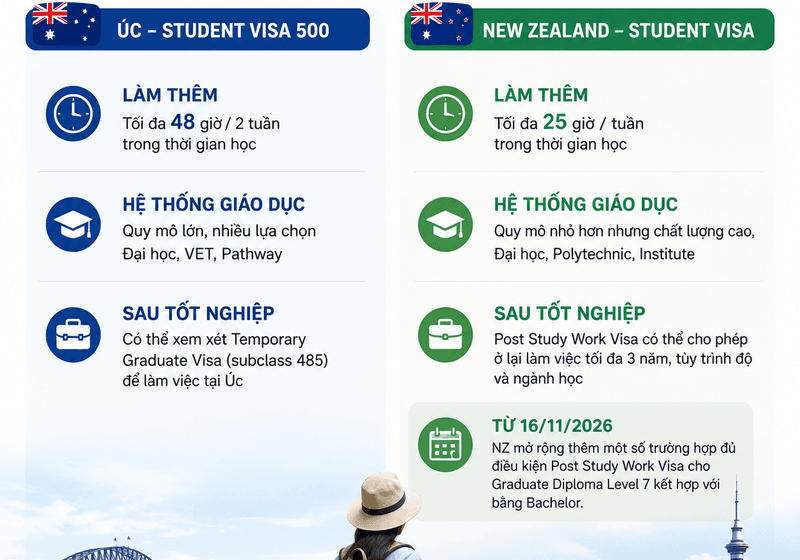

New Zealand's education system
The education systems of New Zealand and Vietnam are different, especially in high school, university and postgraduate. Therefore, the following basic knowledge will help you easily have the right choice of study.
The education system of New Zealand is divided into 3 levels: Kindergarten education; General education (primary, secondary, high school); Higher education and postgraduate. In particular, high school, university and postgraduate are popular education levels selected by young Vietnamese when studying in New Zealand
General education consists of 13 classes, from Grade 1 (5 years old) to Grade 13 (19 years old). The majority of general education schools are public and generally, the schools have quite similar facilities and teaching quality. Most general education schools admit both male and female students, about 10% of schools admit only male or female students, and there are a number of boarding schools. There are also a small number of schools that are private schools, or schools affiliated with churches.
From Grade 1 to Grade 10, students are given the maximum conditions to develop their potential through the New Zealand Cirriculum (NZC). NZC covers many fields, helping students shape a solid foundation for themselves, especially life skills and values. From about the middle of Grade 10, students will begin to determine their future path, with options such as: university, vocational training, work.
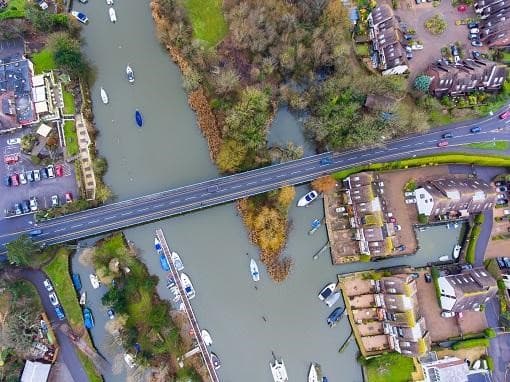
A multi-choice education
High School Level
With the secondary school (also known as Secondary school, or High school, or College), students will study the National Certificate of Educational Achievement (NCEA) program. NCEA is designed to be flexible, suitable for each student's capacity and interests, as well as with the future study orientation that they are interested in. With the form of credit accumulation, NCEA allows high school students to choose the subject according to their strengths. NCEA has 3 levels: 1, 2 and 3 equivalent to Grades 10, 11 and 12 of Vietnam. After level 1 and 2, they can choose to study the next level or transfer to vocational training (after vocational training can still go to university). The high school also teaches many subjects to help students work or apprentice after leaving high school and these subjects are credited so that students can complete NCEA. NCEA certificates are recognized by all universities in New Zealand and in other countries around the world such as the United States, the United Kingdom, Australia, Germany ... NCEA Level 3 equivalent to A-Levels in the United Kingdom and Certificate of Education (ACE) in Australia.
New Zealand's Grade 13 is equivalent to Vietnam's Grade 12 (since New Zealand children start their first grade right after their 5th birthday). New Zealand's high schools are flexible: students do not need to take English language tests (such as IELTS, TOEFL, etc.) but only submit their school reports and if necessary, they will be interviewed or take a language proficiency test to give the school more support in terms of English when they attend the school.
In addition to NCEA, students can choose the International Bachelor (IB) program and the Cambridge International Examinations.

New Zealand, a study abroad destination "about nature"
Undergraduate and Postgraduate
The tertiary and postgraduate levels comprise the system of universities, technical and technological academies and private schools.
University (University)
New Zealand has eight universities, including: University of Auckland, AUT University, Lincoln University, Victoria University of Wellington, Massey University, University of Waikato, University of Canterbury, University of Otago. All public universities are of similar quality. New Zealand is the only country in the world where all public universities are among 3% of the best universities in the world according to the 2017/18 QS World University Rankings. At the same time, the latest statistics of the World University Rankings by Subject show that New Zealand has 22 subjects in the top 50 worldwide. This result comes from the investment of about hundreds of millions of New Zealand dollars per year by New Zealand universities for research. The research and innovation budget of the 08 New Zealand universities accounts for more than a third of the country's research and innovation budget. The system of educational supervision of universities in New Zealand helps ensure high standards and consistency in both teaching and research.
The university offers Bachelor's, Master's, and Doctoral programs. The Bachelor's programs are usually 3 years long (engineering is 4 years, architecture or veterinary medicine is 5 years, and medicine is usually 6 years). Depending on the academic achievement after the 3 year Bachelor's program, students can continue to study for an additional 1 year to earn the Bachelor's Honors Degree. The Master's can be 1 year, 1 and a half, or 2 years long. The average duration of the Doctorate is 3-4 years instead of 4-5 years but many other countries.
Institutes of Technology and Polytechnic (ITPs)
New Zealand has 16 Institutes of Technology, which provide academic, vocational or professional training in a wide range of disciplines, with a focus on highly applicable knowledge and practical experience. ITPs regularly consult with employers to ensure that their programs and students' skills meet the needs of the labour market. In addition to Certificates, Diplomas, ITPs also offer Bachelors, Masters and Doctoral programs, and the value of qualifications is recognised in New Zealand as well as globally.
Private Training Establishments (PTEs)
There are more than 500 registered private schools in New Zealand. Many have courses suitable for specific professions, helping students obtain qualifications and qualifications to be able to work. Examples include air traffic control, pilot and computer training as well as preschool teacher training, tourism and design disciplines.
New Zealand institutions offer a wide range of study options for students, ranging from basic careers such as Science, Engineering, Business Administration, Agriculture to specialised majors with new subjects less taught in other countries around the world, but emerging majors with good job prospects such as Cyber Security, Sports Management, Aviation, Filmmaking, etc.
Another option that many international students choose to study in New Zealand is English courses, from General English to support communication, travel, ... to English courses for IELTS, TOELF, Cambridge; Academic English; Specialized English; these courses are designed flexibly to suit the needs and qualifications of each student.
Source: Internet
For more details and specific advice, please contact:
Greatlink International Study Abroad Co., Ltd.
Hotline: 0936.77.33.86 / 0868.81.79.81
Email: [email protected] or [email protected]