
9 Reasons to Study in Australia from Grade 10
Studying in Australia right from high school brings more advantages to international students, especially in terms of communication and integration, which is very important for those who intend to study and settle permanently in Australia.
Reasons to choose to study in Australia early:
- International standard learning standards, so that you can study in one of the best schools in the world, with small class size personalization (up to 30 students in a class).
- 100% of teachers are trained under international standards, with high professional qualifications.
- High standard facilities – including high-tech qualifications, with all schools having IT systems, computers and internet access.
- Schools often have quite a number of ‘talent and talent' programs to expand the high-achievement students.
- The quality assurance framework is strictly national standards, ensuring that students really understand the lesson, meet the compulsory standards to be able to graduate high school.
- Students are exposed to an international educational environment early to help train independence, increase adaptability and confidence when entering the university lecture hall compared to their peers.
- Build a solid foundation of English, save time studying preparatory courses, English courses. Graduation certificates from high schools in Australia is a solid golden ticket to help students go straight to the door of many prestigious universities in Australia and around the world.
- More opportunities to develop full skills and talents with diverse subjects, easy to breathe, is the foundation for subjects at higher levels, career orientation at an early age
- Suitable for families who intend to settle down. Because, a long stay in Australia is an opportunity to develop a long-term career, as well as to settle down after graduation.
ICSEA – School Assessment Index on Community Educational and Social Advantages

The Community Educational – Social Advantage Index (ICSEA) represents a student's academic performance that, among many other things, is related to several characteristics of the student's family (parental education, parental out - of - school education and occupation) and the school (the student's background and socioeconomic position that it serves).
ICSEA allows parents to have a clear and comparable view of choosing the right school, independent of the financial capabilities of the student's parents or the resources of a school.
The ICSEA is calculated on a scale with an average value of 1000 and a standard deviation of 100. The ICSEA index typically ranges from about 500 (representing schools with extremely difficult student circumstances) to about 1300 (representing schools with extremely favorable student resources). ACARA calculates the ICSEA value for all schools with sufficient data at the national aggregate level.
Learn about the Australian education system
The Australian system of education includes pre-school, kindergarten, primary, lower secondary, upper secondary and tertiary education.
School lasts for 13 years, from kindergarten to high school. School is compulsory until at least 16 years old. Types of school include Public, semi-public and people-founded schools.
Differences in the Australian education system also include schools based on religious beliefs such as Catholic or Islamic schools and schools based on educational philosophies such as Montessori and Steiner.
All schools must be registered with the Department of Education in the State, and must comply with government requirements for teacher infrastructure and quality.
Schools in Australia not only educate students, but also provide momentum to prepare them for life, develop communication skills, self-discipline and respect for themselves and their peers, which is a great momentum for life later.
The schools offer diverse curricula in the main areas of study – English, mathematics, social and environmental studies, science, arts, languages other than English, training in technology, health and physical education.
Education Australia has a strong belief in the benefits of a holistic education – including teamwork, self-expression and personal development outside the formal classroom.
In Australia, students will enjoy a diverse, personalised and educational learning environment while developing the skills and qualities needed in a changing world.
Public High School System
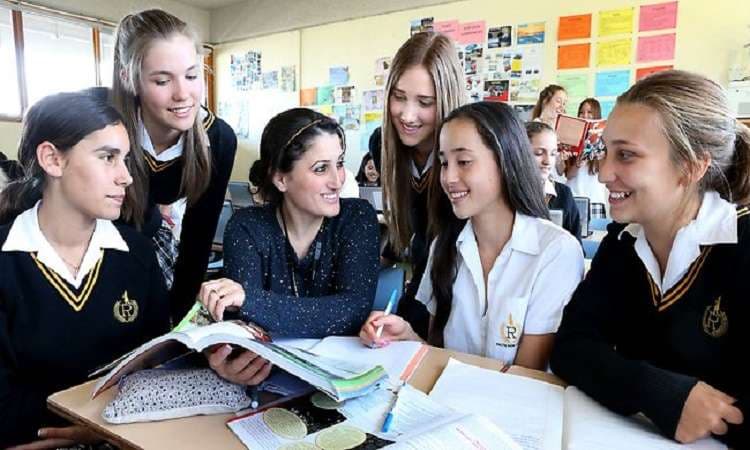
Operated by the State or Territory Government in Australia. This level of education under the Public system will be invested by the government and supported 100% of the cost, so it is much cheaper than private schools. Average tuition fees are 13,000 – 15,000 AUD / year.
The Australian government spends a significant amount of its budget each year on upgrading and investing in infrastructure, teaching and learning equipment, and research to improve and innovate teaching methods.
People-run / private high school system
Owning a flexible and proactive framework of training programs not according to the pre-existing patterns, there are often many separate types, such as schools for boys or girls, Catholic schools ... The cost of studying at private Australian high schools when studying in Australia ranges from AUD 17,000 – 40,000 / year.
Student support on campus
High schools that are allowed to admit and coordinate international students must meet national standards, with a number of student support services, specifically as follows:
- Student Welfare Guarantee Group
- Academic and Life Advisor
- Career advisors to assist students in planning and having a clear study pathway right after high school graduation
- Programs and staff that support English as a Second Language
- International students will often study with native Australian students
- Homestay accommodation: all homestay families must be inspected by the police to meet the requirements of child protection laws
- Housing and living places must meet the compulsory standards; students always have a 24-hour emergency telephone number.
Private schools in Australia have also provided boarding facilities and dormitories for students to live on campus.
Conditions for studying in Australia
Entry requirements in Australia for students under 18 are relatively straightforward: an IELTS score of 5.0–5.5 is required for entry to Grade 10. Students without IELTS can choose one of the following two options:

Study one more semester of English at TAFE or any English language institution in Australia, to be eligible for high school English
Repeat one semester of the previous grade (if entering Grade 10, take an additional semester of Grade 9) to bring your English up to the required standard and keep pace with the high school curriculum. This route does not provide an IELTS score, so you would need to sit the test if you wished to move to another country after high school. The Australian education system accepts international students who have studied at local high schools for university admission without requiring a language certificate.
At the high school level, the Australian Department of Education will also not be required to have a previous secondary school transcript, enabling students from all over the world to participate in the world's leading high schools & universities.
High School Study Abroad Cost Australia
On average in both public and private high schools, tuition fees will fall in the range of 20,000-25.000AUD per year, thereby, the overall cost for 3 years of studying abroad in Australia is calculated as follows:
Category | 1 year's cost | 3 Years Cost |
School fees | 25000AUD | 75000AUD |
Living expenses (In the dormitory) | 9600AUD | 28000AUD |
Travel expenses | 1333AUD | 4000AUD |
Allowance (300AUD/ month) | 3600AUD | 10800AUD |
Total cost of studying in Australia | 39533AUD | 117800AUD |
It can be seen that a total of 3 years of study in Australia will fall in the range of 120,000AUD, falling in the range of 2 billion VND (Actual experience of students, updated in 2014). This is quite accurate data, because the Australian dollar rate and living standards in Australia do not fluctuate much over time.
Please contact us
Greatlink International Translation and Consulting Company
Hotline: 0936.77.33.86/0868.81.79.81
Email: [email protected] or [email protected]
website: greatlink.edu.vn
https://www.facebook.com/GreatlinkInternational