
Finding a part-time job is a popular form for international students, especially for international students who are going to Australia, they always want to find a part-time job to cover part of their tuition fees or living expenses. So do you understand the government regulations or your rights, let's read through the article “Part-time Job Experience in Australia" to understand better!
1. Regulations on overseas employment in Australia for international students
The Australian Government stipulates that international students in Australia under the age of 18 are not allowed to work overtime because they are under the legal working age. If you attempt to work, you or your employer will be fined.
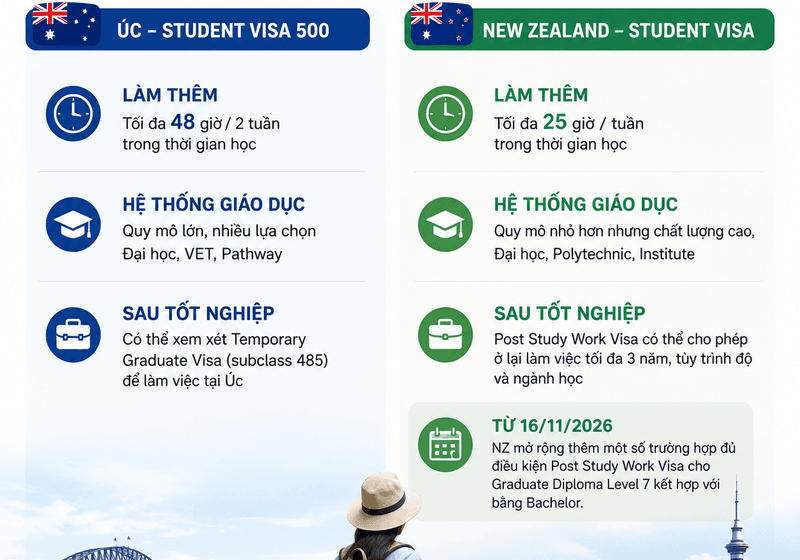
Students over 18 may work part-time for up to 40 hours per fortnight, averaging 20 hours per week, to support their health and academic progress during term. Full-time work is permitted during public and summer holidays.
To get a job, you need to meet the following criteria:
- When your course starts you are allowed to work part-time
- You need to make sure your visa is working and that your visa validity remains.
In case the spouse is accompanied, the right to work overtime like other students as prescribed above, the working time of the accompanying person depends on the other person's level of education. If attending university, the accompanying person is allowed to work as a student (40h/2 weeks during the study period and 40h/1 week during the break). If attending postgraduate (Master's, PhD), the accompanying person is allowed to work full-time (40h/week).
For students studying master's research and doctoral studies, the overtime will be full time. Even for the case of a spouse accompanying, the dependant is also working overtime like the person going to school.
2. Benefits of Working Overtime in Australia
While it is a part-time job, you have distinct rights and benefits like an Australian citizen. All individuals working in Australia, including international students, are entitled to basic employment rights. These benefits ensure that you are not exploited and discriminated against as a native worker, such as working in a safe environment, enjoying evening pay, leave, and insurance that is worth the effort.
To work part-time, register for a Tax File Number (TFN) with the Australian Taxation Office to avoid being taxed at a higher rate. For people staying in Australia for more than six months, the first AUD 6,000 of employment income is tax-free, as it is for other Australian residents. A bank account also makes receiving wages, paying tax and managing superannuation easier.

3. Do I need to apply for work-permit and insurance to work overtime in Australia?
Most students do not need to apply for a work permit. However, there are some exceptions to work overtime related to health service such as child care, in the elder care or work at the clinic, dentistry, students will be required work permit.
Do you need to buy insurance?
Under Australian Government law, you do not need to buy insurance to go to work, but your employer will be the one to buy insurance to protect you in case you get an injury or occupational accident at work. If something unfortunate happens to you, your insurance will pay for medical treatment or your salary until you can go back to work.
4. Working overseas in Australia for a pension?
Have you ever heard of working overtime and enjoying retirement? It sounds ridiculous but it is completely reasonable. In Australia when you work overtime you will also enjoy retirement or, more precisely, pension.
Superannuation, also known as “Superannuation”, is a type of pension that you can receive. Even if you are a part-time worker, there are companies that contribute at least 9.5% of your income to the pension fund. When you return to your home country, you can get this money back and take it with you if you are eligible. You should try to find quality part-time jobs and register a tax code to enjoy this regime.
5. Popular Overtime Jobs in Australia
Some of the most popular part-time jobs in Australia for students can be found here:-
- Retail: International students often look to milk tea shops, fast food restaurants (Mc Donalds, KFC ...), or Starbucks to serve, or work in the counter. Positions students can undertake as a salesperson, palletizer, or packer at any type of retail store, packaging from clothing to electronics this is quite common in Australia. Places of employment you can be a small store, a chain of convenience stores, and also large supermarket chains.
- Services: Some places where you can try to find service related jobs are cinemas, restaurants, bars, hotels, and fitness centers. You can also work at gas stations, or customer service switchboards, market surveys. These jobs may require you to have some previous experience or certification. For example, to work as a bartender in Australia, you are required to undergo a training course revolving around Responsible Service of Alcohol (RSA). The advantage is that this training can be completed online to obtain a work certificate. This work area is very helpful for you in communication skills, situational skills and customer care related skills.
- Tutor: You can work as a tutor for students who need support while you study in school. Moreover, you can also teach Vietnamese to children at overseas Vietnamese families living in Australia. This can be said to be an interesting job, relatively close and simple with Vietnamese students. You can both improve your knowledge and improve your language ability.
- Seasonal work: You can work part-time at the market or become a farmer on farms in Australia. This is a great work experience if you want to explore the nature and peaceful life in the Australian countryside. Your main job is to harvest farm produce, sort food and sell it at the market. On summer vacation, you can work full time with a variety of harvested farm produce. You can earn a decent amount to cover tuition and basic living in the next school year.
- Additional jobs associated with the discipline: You can also get jobs in the campus or local businesses and agencies. For example, if you are a media student, you can work part-time at a local television or radio station, or a law student can apply to the legal advisory department for international students on visa matters, residence card registration. Of course, these jobs are few and competitive rates are also higher. In addition, you can also apply for jobs at companies that are applying for part-time positions related to your major.

6. Benefits of Working Overseas in Australia
- Know how to manage your time: You will know how to arrange and ensure time for studying, work in accordance with your time. To ensure that extra work does not affect much to study, international students often need to find employment opportunities with time in accordance with the schedule, convenient travel with clear and legal labor contracts.
- Enhance your soft skills: Part-time work helps you accumulate various soft skills such as handling work situations, communicating with colleagues and customers and life skills.
- Have a lot of experience: When you prioritize to do jobs that are directly related to the career path you plan to pursue, you will have a lot of experience to learn, expose and get used to the things you can do in the future. This will greatly help your competence and make your CV more attractive.
7. Minimum salary
Your overtime pay in Australia will be paid for each job you do and for each region you live and study in. Legal overtime jobs will be paid the statutory minimum wage (approximately AUD 17.93 per hour).
There are jobs like waitress in Sydney or Melbourne that are about 14 – 16 AUD less than the average wage. If you are fluent in English, you can try applying for a job as a telemarketer or outdoor surveyor and you work in a healthcare-related job and your wage will be about 20 – 22 AUD. High-paying jobs also require high selection criteria.
8. Where can you apply for a job
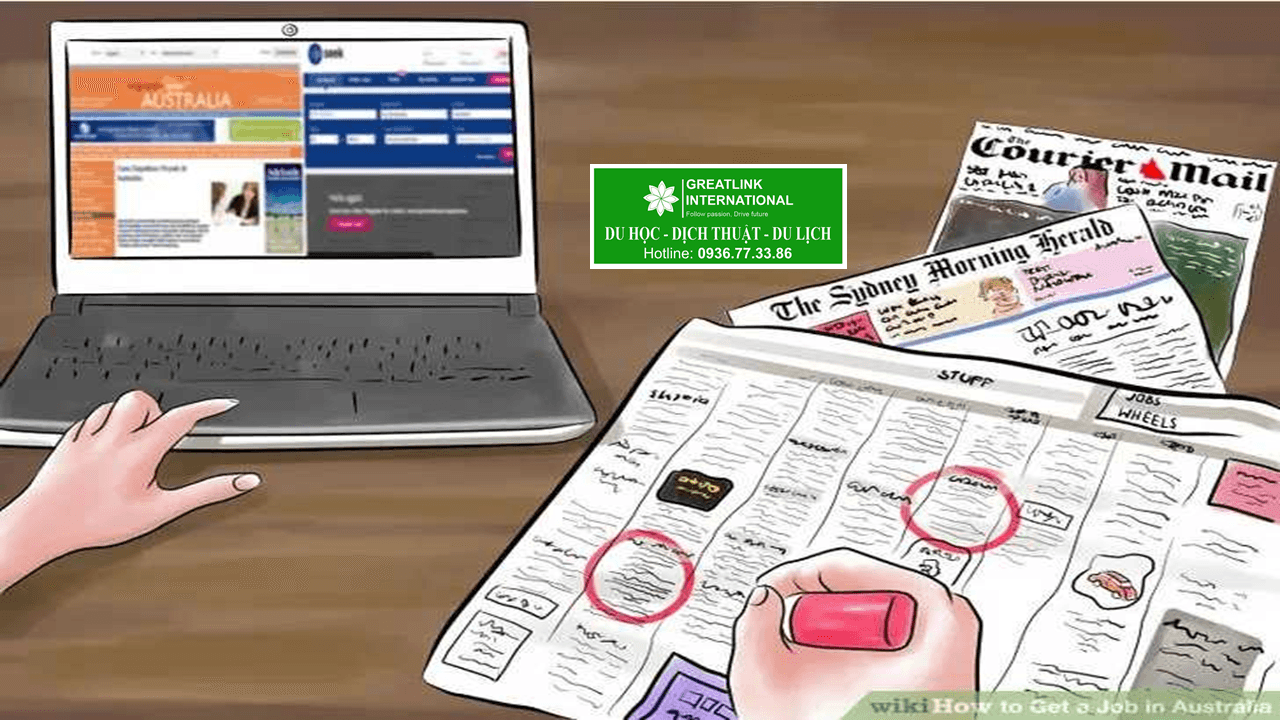
- You can go directly to retail stores, supermarkets, or restaurants or hotels ... and ask the store manager if there are any vacancies that you can apply and take on. In case there are no vacancies, you can leave your resume for them to consider in the next recruitment.
- Search in the “career” section of companies' websites for open positions. Many international students have received information about short-term jobs by posting resumes and applying directly to companies in this way.
- Read on-campus and online job boards. Your university will also have a careers center, where you can connect with employers.
- And finally, the most popular and easiest to use is the online job search engine that uses popular Australian job search channels, such as Seek, MyCareer, CareerOne, ApplyDirect, and Jora.
Please contact us
Greatlink International Consulting and DT Company
Hotline: 0936.77.33.86/0868.81.79.81
Email: [email protected] or [email protected]
website: greatlink.edu.vn
https://www.facebook.com/GreatlinkInternational